
Realistic Patient Mannequins: Which Medical Simulation Company Truly Delivers the Best Results in India?
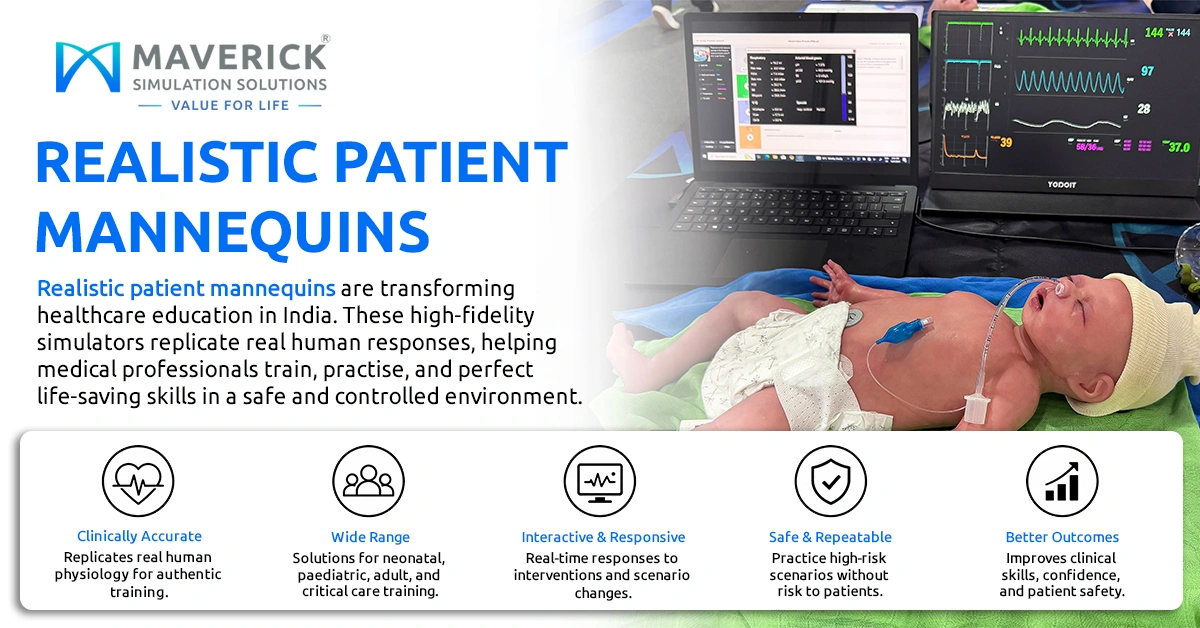
Realistic patient mannequins are the cornerstone of high-fidelity medical simulation. Maverick Simulation, based in New Delhi, India, is one of the country’s leading manufacturers offering a comprehensive range of patient mannequins that replicate human physiology with clinical accuracy. From neonatal and paediatric simulators to adult critical care mannequins, Maverick’s range is deployed across leading hospitals and medical institutions nationwide.
Table of Contents
1. What Are Realistic Patient Mannequins?
Realistic patient mannequins are high-fidelity medical simulators designed to replicate human anatomy and physiological responses with precision. Unlike basic anatomical models, a realistic patient mannequin breathes, produces heart and lung sounds, has palpable pulses, responds to drug administration, and can simulate clinical deterioration in real time.
The term covers a wide spectrum — from low-fidelity to advanced high-fidelity systems with embedded computers, programmable vital signs, responsive airways, and the ability to speak ,respond to the treatment or cry while treating a patient during a simulation scenarios.
In the context of medical simulation in India, realistic patient mannequins are now the standard training tool for emergency medicine, critical care, neonatal resuscitation, paediatric emergencies, and obstetric training.
The global patient simulators market reached $2.56 billion in 2025 and is projected to grow to $5.36 billion by 2030 at a CAGR of 16.1%. Asia Pacific is the fastest growing region, driven significantly by India’s rapid medical education expansion. (Source: The Business Research Company, Patient Simulators Global Market Report 2026)
2. Why Realistic Patient Mannequins Matter for Clinical Training
The World Health Organisation (WHO) estimates that 1 in 10 patients in low-to-middle-income countries experiences a preventable medical error during hospital care. Simulation-based training using realistic patient mannequins is one of the most evidence-backed interventions to reduce that number — allowing clinicians to practise high-stakes scenarios before encountering real patients.
Without Realistic Mannequins
With Realistic Patient Mannequins
Skills practised on static unresponsive models
Dynamic physiological responses mirror real patient behaviour
No feedback on clinical decisions
Vital signs respond to correct and incorrect interventions
Inconsistent training quality
Standardised, repeatable scenario delivery for all learners
Risk of incorrect technique becoming habitual
Anatomically accurate resistance and tissue response
No team-based emergency training
Full team training: doctor, nurse, paramedic together
Difficult NMC CBME documentation
Session logs and performance data for accreditation
3. The Global and India Market for Realistic Patient Mannequins
The demand for realistic patient mannequins is growing faster than any other medical simulation segment — driven by regulatory mandates, rising patient safety standards, and rapid expansion of medical education infrastructure in India.

India’s medical simulation market generated USD 87.4 million in 2024 and is projected to reach USD 249.4 million by 2030, growing at a CAGR of 19.2%. The National Medical Commission (NMC)’s CBME mandate has made realistic patient mannequins a required component of accredited medical skill labs, accelerating institutional investment significantly.
India’s Ministry of Health has allocated approximately USD 45 million for simulation education initiatives — a clear signal that realistic patient mannequins are now national healthcare education infrastructure, not optional equipment. (Source: Coherent Market Insights, Mannequin-Based Simulation Market Report)
4. What Makes a Patient Mannequin Truly Realistic?
Not every mannequin sold as a ‘patient simulator’ qualifies as a truly realistic patient mannequin. Here are the clinical and technical criteria that separate high-fidelity systems from basic training models:
India’s Ministry of Health has allocated approximately USD 45 million for simulation education initiatives — a clear signal that realistic patient mannequins are now national healthcare education infrastructure, not optional equipment. (Source: Coherent Market Insights, Mannequin-Based Simulation Market Report)
Physiological responsiveness
A truly realistic patient mannequin responds dynamically to clinical interventions. Administer a vasopressor correctly and blood pressure rises. Fail to secure an airway and oxygen saturation drops. This closed-loop physiological feedback is what transforms passive training into genuine clinical decision-making practice.
Anatomical accuracy
The mannequin’s surface anatomy must mirror a real patient — correct landmark positioning for IV access, chest compressions, airway management, and auscultation. Incorrect anatomical proportions produce incorrect muscle memory that creates risk when trainees transition to real patients.
Realistic airway and respiratory mechanics
The airway must offer appropriate resistance to bag-mask ventilation, intubation, and supraglottic device insertion. The chest must rise and fall visibly with ventilation. These details are non-negotiable for realistic patient mannequins used in anaesthesia and emergency medicine training.
Heart , lung & bowel sounds
High-fidelity mannequins produce programmable cardiac , respiratory and bowel sounds audible through a stethoscope — including normal and pathological variants. This allows trainees to practise auscultation-based diagnosis as part of every simulation scenario.
Instructor software and scenario programming
The best realistic patient mannequins are driven by instructor software that allows educators to programme clinical scenarios, adjust physiological parameters in real time, trigger clinical events, and record performance data for structured debriefing. This is what separates a training tool from a clinical education platform.
5.Maverick Simulation's Realistic Patient Mannequin Range
India's most comprehensive realistic patient mannequin portfolio
Maverick Simulation is a DSIR-recognised manufacturer based in New Delhi, India, designing and producing realistic patient mannequins for hospitals, medical colleges, nursing institutes, and paramedical training centres. As a manufacturer rather than a reseller, Maverick controls quality at every stage, offers competitive institutional pricing, and provides local after-sales support across the country.
Simulator
Patient Type
Fidelity
Primary Use
SIDDH
Adult, Critical Care
High-Fidelity
Emergency, ACLS, ICU, anaesthesia,respiratory, drug dosing, ultrasound
Mia
Neonatal
High-Fidelity
NICU, neonatal resuscitation, ventilation
Arthur
Paediatric
High-Fidelity
Paediatric emergencies, drug dosing practice
LuSi (Lung Simulator)
Neonatal / Infant
High-Fidelity
Neonatal ventilation, HFOV training, NICU
TestChest (Lung Simulator)
Adult
High-Fidelity
Mechanical ventilation, ICU, respiratory therapy
6. Who Uses Realistic Patient Mannequins in India?
- Medical colleges and teaching hospitals: Emergency medicine and anaesthesia teams training for ACLS, code blue, and airway management scenarios, etc.
- Hospital skill labs: NICU nursing teams practising neonatal resuscitation and ventilator management, etc
- Medical simulation centres: MBBS Phase 2 and Phase 3 students learning clinical examination and bedside procedures
- PG training programmes: Postgraduate residents in internal medicine, surgery, and obstetrics building procedural competency
- Nursing colleges: Nursing faculty delivering standardised clinical skill sessions aligned to NMC CBME requirements
- Paramedical institutes: Paramedical teams rehearsing pre-hospital emergency care scenarios
7. How to Choose the Right Realistic Patient Mannequin for Your Institution
Step 1: Define your training objectives
Identify which clinical specialties and competency levels need the most support. An emergency department running Critical care programmes needs a high-fidelity adult mannequin like SIDDH. A neonatal ward needs Mia. A nursing college running clinical examination modules may start with LISA for ACLS training and much more..
Step 2: Match fidelity to learner stage
Undergraduate students benefit most from mid-fidelity mannequins for examination and basic procedural practice. Postgraduate trainees gain most from high-fidelity scenario-based training on systems like SIDDH , LuSi, TestChest
Step 3: Plan for lab infrastructure
A realistic patient mannequin performs best within a purpose-designed simulation environment. Maverick’s turnkey simulation lab solutions include civil design, AV monitoring, debriefing rooms, and equipment installation as a complete package.
Step 4: Invest in faculty training
The quality of simulation outcomes depends as much on the facilitator as on the mannequin. Maverick’s SimAcademy provides structured faculty development programmes to ensure your team can design, run, and debrief simulation scenarios effectively.
Step 5: Ensure accreditation alignment
Confirm that your realistic patient mannequin setup generates the session logs and competency records needed for NMC CBME, NAAC, and NABH documentation. Reference SSH Society for Simulation in Healthcare standards for internationally recognised simulation centre benchmarking.
Frequently Asked Questions (FAQs)
1. Which medical simulation company offers realistic patient mannequins in India?
Maverick Simulation, based in New Delhi, India, is one of the country’s leading manufacturers of realistic patient mannequins. Their range includes the SIDDH Critical Care Simulator (adult, high-fidelity), Mia Neonatal Simulator, LuSi, TestChest Arthur Paediatric Simulator, MATT auscultation simulator, and Lisa Female Patient Simulator — all designed and manufactured in India with local after-sales support.
2. What is a realistic patient mannequin used for?
A realistic patient mannequin is used to train doctors, nurses, and paramedics in clinical skills, emergency procedures, and team-based scenario training — without any risk to real patients. Applications include ACLS, airway management, neonatal resuscitation, paediatric emergencies, clinical examination, and obstetric training.
3. What is the difference between a high-fidelity and low-fidelity patient mannequin?
A high-fidelity patient mannequin replicates full human physiological responses — breathing, pulse, programmable vital signs, drug reactions, heart and lung sounds. A low-fidelity mannequin is a simpler anatomical model for basic procedural practice such as suturing, IV cannulation. High-fidelity systems are used for complex scenario-based team training.
4. How much does a realistic patient mannequin cost in India?
The cost varies based on fidelity level and features. Mid-fidelity systems are significantly more affordable than high-fidelity platforms. Maverick Simulation offers competitive institutional pricing, supports government tender documentation, and provides customised quotes based on specific clinical training requirements.
5. Are realistic patient mannequins required for NMC accreditation?
Yes. The National Medical Commission (NMC) has integrated simulation-based clinical skill assessment into its Competency-Based Medical Education (CBME) framework. Realistic patient mannequins are among the tools explicitly referenced in NMC skill lab infrastructure requirements for accredited medical colleges in India.